

Research report
Designing the Future Together: Latino Communities and California’s AI Agenda
18 minute read
Published July 23, 2026
Key Findings
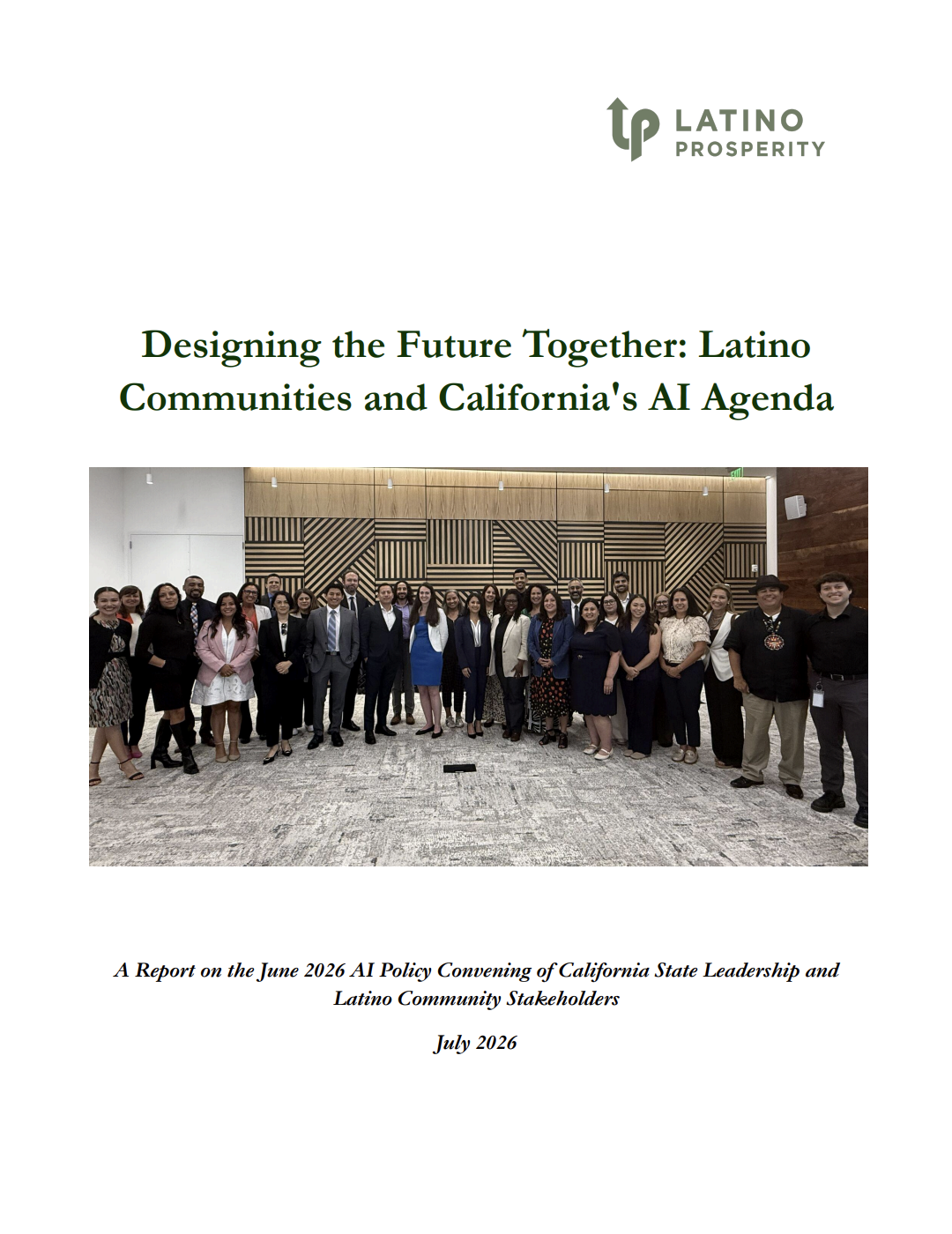
- This report summarizes a June 17th, 2026 convening in Sacramento that brought together Latino community leaders and senior officials from the Newsom Administration to discuss how California’s AI agenda can better reflect and serve Latino communities, who make up nearly 40% of the state’s population.
- California is home to 33 of the top 50 privately held AI companies globally and is uniquely positioned to lead the AI economy, yet as nearly 40% of the state’s population, Latinos remain largely absent from the institutions and decisions shaping not only economic opportunity, but also efforts to reduce the risk that increasingly powerful AI systems cause severe, large-scale harm to Californians and humanity.
- Four Latino leaders were recently appointed to state AI-related bodies under the Newsom Administration, after community leaders requested a seat at the table. Participants emphasized that meaningful inclusion requires influence over policy and resources, not just a seat at the table.
- Participants pushed back on a retraining-only frame that treats workers as passive recipients of whatever jobs AI leaves behind. They called instead for structural power: a fixed share of seats on existing AI governance bodies (30 to 40%) held by worker organizations and community organizations with full voting rights, so workers can shape how AI is deployed in their industries in the first place, not just adapt to decisions made without them.
- AI-driven workforce disruption will extend well beyond tech occupations. Administrative staff, customer service representatives, and accounting professionals, roles where Latino workers are heavily concentrated, face significant transformation as AI adoption accelerates.
- Digital inclusion remains a prerequisite for AI readiness. Persistent gaps in broadband access, digital literacy, language accessibility, and technology affordability threaten to blunt the impact of workforce training investments if left unaddressed.
- Latino-owned businesses show strong interest in AI but uneven readiness. Organizations serving entrepreneurs report growing curiosity alongside wide variation in awareness, technical support, and access, raising the risk that Latino firms become late adopters rather than early beneficiaries.
- Environmental and civil rights concerns are converging with AI policy. Data center expansion (water use, energy demand, air quality) and algorithmic risks (biased hiring, lending discrimination, surveillance) disproportionately threaten working-class and Latino communities absent early safeguards.
- Long-term Latino prosperity will hinge on ownership, not just adoption. Participants framed AI as fundamentally a wealth-building question: who owns AI-enabled businesses, controls data, and captures productivity gains, rather than simply a technology-access question.
Share


Latino communities are engaging directly with California’s AI policymakers, but presence in the room isn’t the same as power over outcomes. The June 17th convening made clear that closing the Latino wealth gap in an AI economy, and ensuring Latino leadership in preventing AI’s most severe risks, will depend on ownership, representation, and sustained influence, not one-time consultation.

More Research
The Latina Economic Power Agenda
Latinos are increasingly fueling California’s economy, driving labor markets, entrepreneurship, and consumer spending in the nation’s most populous and economically influential state.

Latina Economic Power Agenda
Listening Sessions Latina Economic Power Agenda Virtual Webinar October 8, 2026 10:00a.m.-11:00a.m. PT
Closing the Latino Wealth Gap: An Illinois Conversation
Latinos are increasingly fueling California’s economy, driving labor markets, entrepreneurship, and consumer spending in the nation’s most populous and economically influential state.


